What are LLMs?
LLM stands for “Large Language Model.” These are advanced AI systems designed to understand and generate human-like text based on the input they receive. These models have been trained on vast amounts of text data and can perform a wide range of language-related tasks, such as answering questions, carrying out conversations, summarizing text, translating languages, and much more.
LLMs have the ability to achieve state-of-the-art performance in multiple Natural Language Processing (NLP) tasks, such as machine translation, sentiment analysis, summarization, and more. They can also generate coherent and contextually relevant text based on given input, making them highly useful for applications like chatbots, question-answering systems, and content generation.
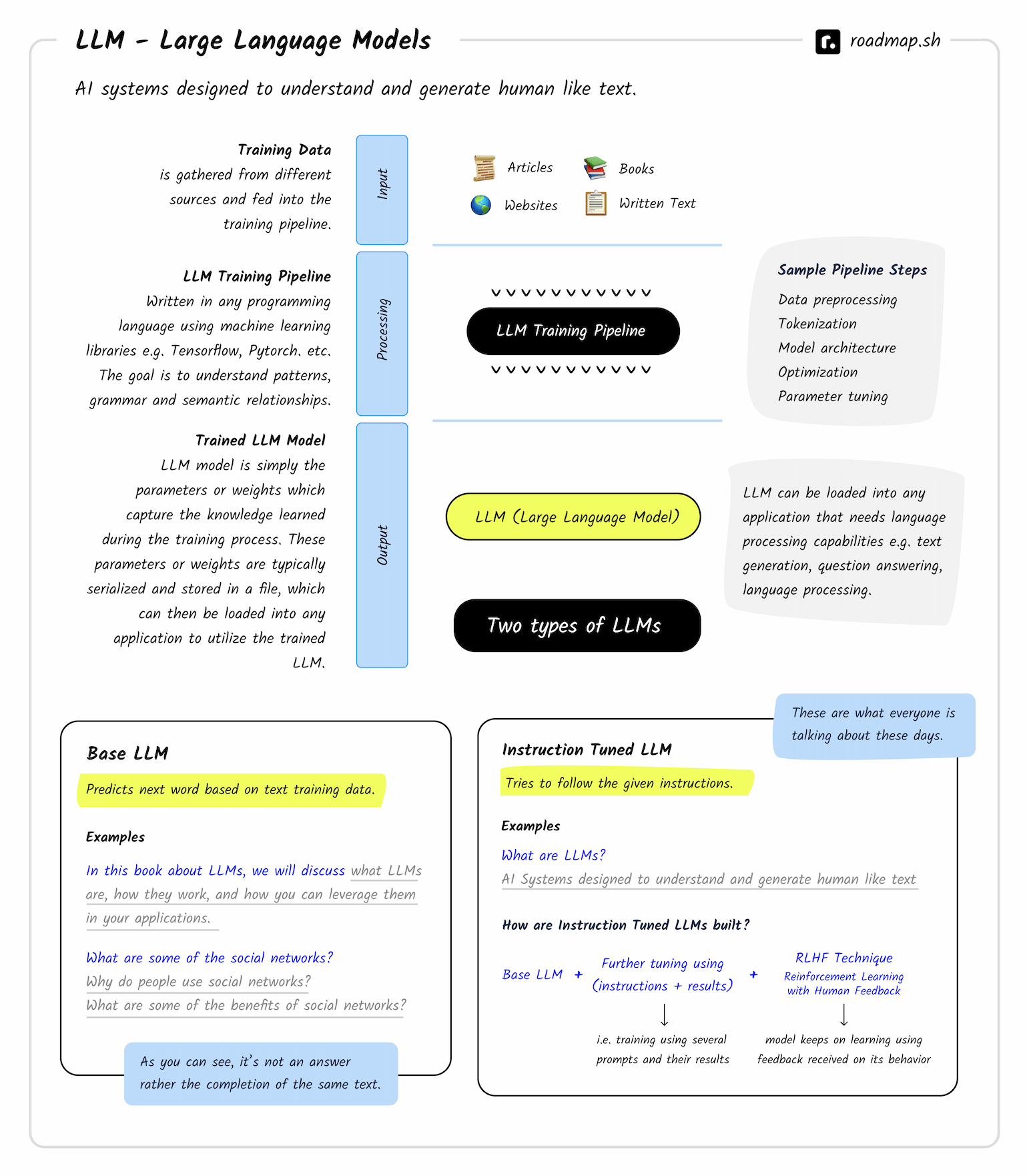
OpenAI has been a major contributor to this space in the past few years with their models and research. However, there are other players in the market as well e.g., Meta with their OPT, OPT-IML and LLaMA models, Google released FLAN-T5 and BERT, StableLM by Stability AI, Alpaca at Stanford and there are many other opensource models as well.
Key Capabilities of LLMs
Answering your questions: LLMs can access and process information from various sources to provide comprehensive and informative answers to your queries.
Engaging in conversations: LLMs can understand the context and nuances of human language, allowing them to participate in natural and engaging conversations.
Summarizing text: LLMs can extract the key points and condense lengthy documents into concise summaries, saving you valuable time and effort.
Translating languages: LLMs can overcome language barriers by translating text between different languages with impressive accuracy and fluency.
Content generation: LLMs can generate various creative text formats, such as poems, scripts, and code, fostering innovation and exploration in diverse fields.
Training and Development
The development of LLMs involves three crucial stages:
Data Collection: Massive amounts of text and code are gathered from various sources, including books, articles, code repositories, and online conversations.
Training: The collected data is fed into complex algorithms, allowing the LLM to learn the statistical relationships and patterns within the language. This process can be computationally intensive and require significant resources.
Evaluation: The performance of the LLM is evaluated on various tasks to assess its effectiveness and identify areas for improvement. This may involve human feedback and refinement through techniques like reinforcement learning.
Types of LLMs
Base LLMs: These models focus on predicting the next word based on the context they have been trained on. While they may not directly answer questions, they can generate relevant and grammatically correct text.
Instruction-tuned LLMs: These models are further trained to follow specific instructions and answer questions directly. They build upon the capabilities of Base LLMs and incorporate techniques like human feedback to refine their responses.
Instruction Tuned LLMs = Base LLMs + Further Tuning + RLHF. To build an Instruction Tuned LLM, a Base LLM is taken and is further trained using a large dataset covering sample “Instructions” and how the model should perform as a result of those instructions. The model is then fine-tuned using a technique called “Reinforcement Learning with Human Feedback” (RLHF)