Introduction
Large Language Model evaluation refers to the process of assessing the performance, capabilities, and limitations of these complex AI systems. It's a crucial step in understanding how well LLMs function and identifying areas for improvement.
LLM Evaluation
Evals are vital for identifying the strengths and weaknesses of LLM prompts, guiding deployment and iteration decisions.
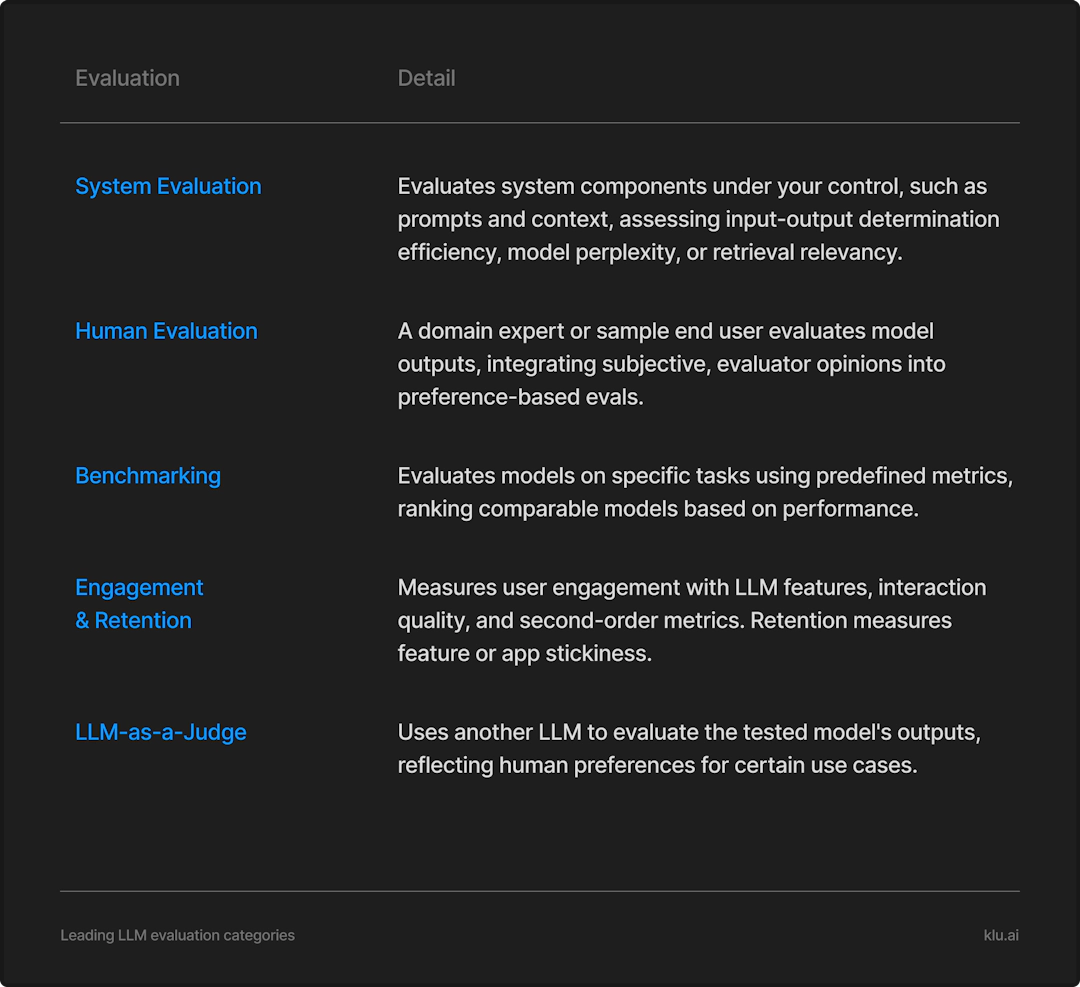
LLM Evaluation can be conducted using different methods, including:
Domain-Specific Datasets
Using datasets relevant to a particular industry or application to assess performance.
Adversarial Testing
Evaluating robustness against adversarial attacks to test resilience to various adversarial inputs.
Prompt and Context Evaluation
Assessing how well inputs (prompts) determine outputs, which may involve changing the prompt template while holding the LLM constant.
Automated Metrics
Utilizing libraries and tools such as Klu.ai or the OpenAI Eval library, which includes metrics like HellaSwag, TruthfulQA, and MMLU.
Evaluating LLMs is essential for enhancing their alignment with human values and ensuring their utility, safety, and fairness. This evaluation is also key to choosing the best model for specific applications and is a core aspect of LLMOps, which focuses on LLM development and optimization.
Important LLM evaluation
Improve model performance
By identifying weaknesses, developers can refine the model and enhance its capabilities.
Ensure responsible development
Evaluation helps identify and mitigate potential biases, fairness issues, and safety risks associated with LLMs.
Choose the right model for the task
Comparing different LLMs through evaluation helps select the one best suited for a particular application.
Build trust and transparency
By understanding how LLMs work and their limitations, users can make informed decisions about their use.
LLM Evaluation working
Large Language Models (LLMs) evaluation involves appraising factors like language fluency, coherence, contextual understanding, factual accuracy, and the ability to generate relevant and meaningful responses.
To evaluate LLMs, there are several methods and frameworks available, such as:
LLM System Evaluation
Platforms like Klu.ai offer automated evaluations using algorithms, code, embeddings, human feedback, or LLM-as-a-judge feedback to streamline the evaluation workflow. This is a complete evaluation of components that you have control of in your system, such as the prompt (or prompt template) and context. LLM system evaluations assess how well your inputs can determine your outputs. The outcome metric for this evaluation depends on what you are trying to evaluate.
Human Evaluation
This method involves human judges who assess the quality of the model's outputs based on various criteria. It is considered the gold standard for assessing LLMs as it can capture nuances that automated metrics might miss, providing a comprehensive understanding of a model's performance. However, it can be subjective, prone to bias, and time-consuming, especially for large-scale evaluations.
User Engagement and Satisfaction Metrics
These metrics measure how often the user engages with the LLM features, the quality of those interactions, and how likely they are to use it in the future. These metrics are applicable to any LLM and can be built directly from telemetry collected from AI models.
Automated Metrics
These include metrics like BLEU or ROUGE, which require reference data for comparison. These metrics are often used in conjunction with other evaluation methods for a more comprehensive assessment of LLM performance.
Benchmark Tasks
These include evaluations like AlpacaEval, MT-Bench, GAIA, MMMU, or MMLU, which use standardized questions and answers to assess model performance. These benchmarks are great for showcasing relative LLM performance, but may not fully reflect the challenges of real-world applications. The benchmarks evaluate on a controlled dataset that may not generalize well to diverse and dynamic scenarios where LLMs are deployed.
Combining these evaluation methods creates a more accurate picture of the model's performance and highlights areas for improvement. The choice of evaluation method for LLMs depends on factors like cost and accuracy, however establishing robust evaluation procedures is crucial for any LLM-based system, and it's advisable to gather task-specific evaluations such as prompt, context, and expected outputs for reference.
Leading eval benchmarks
Model | Arena Elo rating | MT Bench | AlpacaEval 2 | MMLU |
|---|---|---|---|---|
1253 | 9.32 | 50.00% | — | |
1224 | 9.18 | 16.85% | 71.8 | |
1190 | 8.96 | 22.07% | 86.4 | |
1160 | 9.18 | 15.76% | — | |
1150 | 8.61 | 21.86% | 75.3 | |
1149 | 7.9 | 16.99% | 77 | |
1131 | 8.06 | 17.19% | 78.5 | |
1123 | 8.3 | 18.26% | 70.6 | |
1120 | — | 16.85% | 71.8 | |
1119 | 8.18 | 15.73% | — | |
1116 | 8.39 | 14.13% | — | |
1110 | 7.85 | 16.99% | 73.4 | |
1110 | 7.89 | 15.98% | — | |
1110 | — | 29.66% | 73.5 | |
1111 | — | 16.85% | 71.8 | |
1105 | 7.94 | 14.13% | 70 |